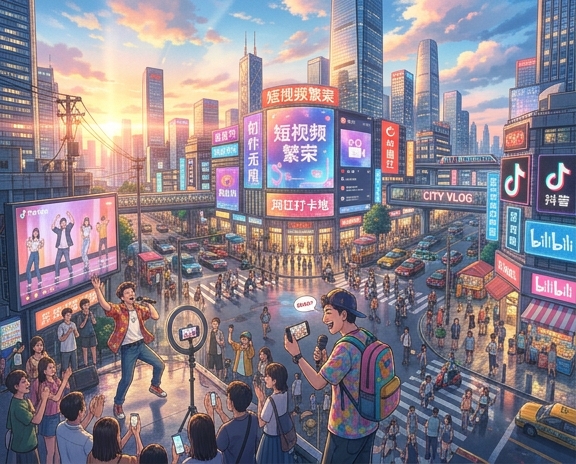
The Evolution of China's Short-Form Video Industry: A New Era for Actors and Content
In China, the short-form video industry is experiencing a transformative phase, with actors diversifying their careers and content evolving into long-form media.
The short-form video industry in China, a rapidly growing sector, is currently undergoing a significant transformation. This shift is not only reshaping the content landscape but also the careers of actors and content creators.
In recent times, several renowned actors such as Ke Chun, Yu Yin, Wang Gege, and Liu Xiaoxu, who have gained popularity through their hit short-form videos, are now exploring new avenues. Some are venturing into the big screen, while others are making their mark in the drama industry. This trend reflects a broader move towards diversification, as highlighted in a previous article, 'Can Short Videos Still Accommodate Real-Life Actors?' This piece noted that while top actors are branching out into variety shows and cross-industry collaborations, new talents must wait until they have established their own representative works and a solid fan base. This approach avoids the intense competition, or 'internal struggle,' that often plagues the industry.
The transformation is not limited to individual actors. At the institutional level, there is a noticeable shift towards long-term asset development. For instance, popular short-form video series like 'A Good Daughter,' 'A Family of Three in the Same Class,' and 'Flipping the Table,' which have amassed over 4 billion views, are now being adapted into films, long-form dramas, and even overseas remakes. This strategic move is facilitated by securing government film bureau approvals and attracting participation from traditional film industry chains.
The rise of platforms like Tinghua Island and Zhangwan Network, which are leading the way in this transformation, is particularly noteworthy. These platforms are not only focusing on the domestic market but are also building overseas streaming platforms. This strategic move is aimed at converting one-time hits into a sustainable, long-term asset portfolio that includes films, long-form dramas, and international remakes.
In this evolving landscape, the short-form video industry is not just a platform for entertainment but is also becoming a launchpad for new talents and content formats. The industry's shift towards long-form content and international expansion reflects a broader trend in the entertainment industry, where traditional and digital media are converging.
For instance, the trend of actors moving from short-form to long-form content echoes the career paths of many Western actors. Just as Hollywood stars like Leonardo DiCaprio and Jennifer Lawrence have transitioned from film to television, Chinese actors are now exploring similar opportunities. This trend is not only beneficial for the actors but also for the industry as a whole, as it fosters a more diverse and dynamic content ecosystem.
The cultural significance of this transformation cannot be overstated. In China, the entertainment industry is deeply intertwined with social and cultural values. The shift towards long-form content and international collaboration reflects a broader trend of cultural exchange and global integration. It also highlights the evolving role of technology in shaping the entertainment landscape.
In conclusion, the short-form video industry in China is entering a new era, marked by diversification, innovation, and global expansion. This transformation is not just reshaping the industry but is also contributing to the broader cultural and social fabric of China.